An Aussie take on a European classic using roasted ground wattleseed.
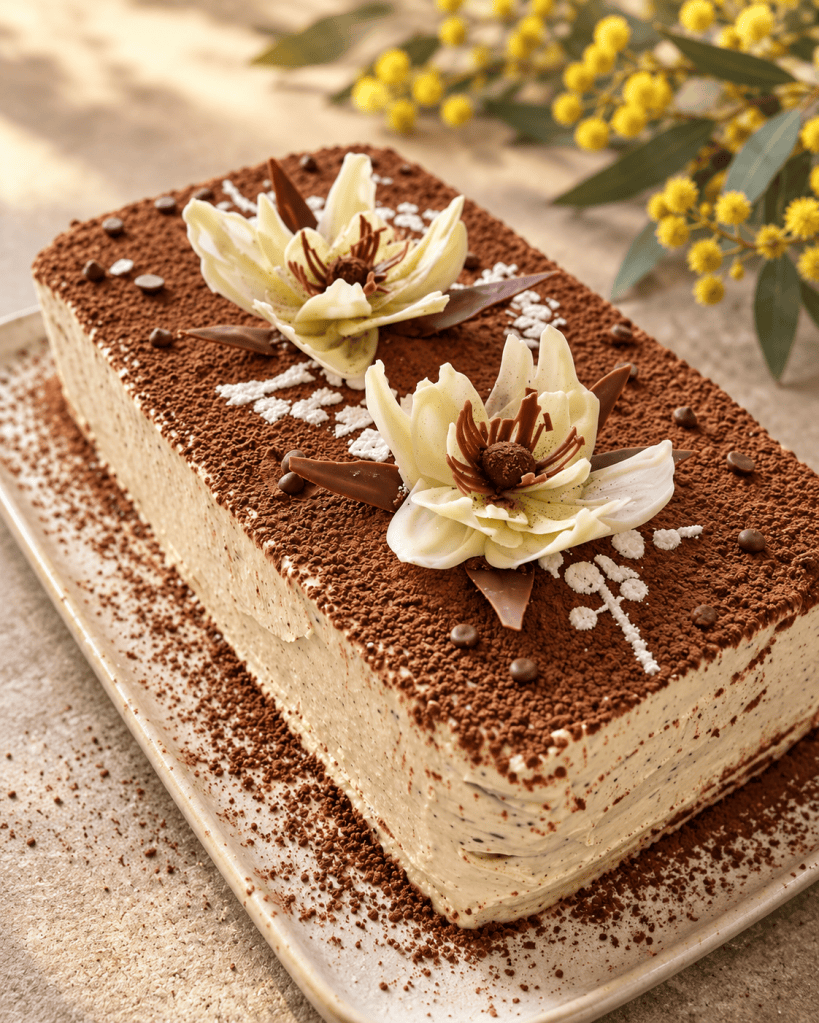
This stable, egg-free tiramisu is designed to be made ahead, unmoulded as a clean rectangular slab and finished just before serving. Roasted wattleseed deepens the coffee and chocolate notes without overpowering the mascarpone.
Equipment
- 23 x 13 cm loaf tin, approximately 7 cm deep, plus plastic wrap and a strip of baking paper or acetate
- Electric beaters or stand mixer, shallow dish and fine sieve
- Small branch-and-berry stencil
- Acetate sheets or baking paper, 2 small clean pastry brushes and disposable piping bag for flowers
Ingredients:
- 35 g brown sugar
- 350 ml strong espresso or strong coffee, cooled
- 1 1/2 tsp finely ground roasted wattleseed
- 1 tsp vanilla extract
- Pinch of fine salt
- 600 g mascarpone, cold
- 400 ml thickened cream, cold
- 90 g icing sugar, sifted
- 1 1/2 tsp finely ground roasted wattleseed
- 1 tsp vanilla extract
- Pinch of fine salt
- 300 to 350 g savoiardi biscuits
- Unsweetened cocoa powder, for dusting
- Icing sugar, for the stencil
- 120 g white couverture chocolate or white compound chocolate
- 15 g dark chocolate for centres and leaves
Method:
Make the tiramisu
1. Prepare the tin Lightly dampen the inside of the loaf tin so the lining grips. Line with two generous overlapping sheets of plastic wrap, leaving enough overhang to cover the top. Add a neat strip of baking paper or acetate along the base and long sides for a cleaner finish.
2. Make the coffee soak Stir the hot espresso, brown sugar, wattleseed, vanilla and salt until the sugar dissolves. Cool completely. Pour into a shallow dish. The wattleseed will settle slightly; stir the soak every few biscuits so the flavour stays evenly distributed.
3. Whip the cream Beat the thickened cream, icing sugar, wattleseed, vanilla and salt to soft-medium peaks. In a separate large bowl, loosen the cold mascarpone with a spatula just until smooth. Fold in one-third of the whipped cream, then gently fold in the remainder. Stop as soon as no streaks remain; overmixing can split mascarpone.
4. Build the first layer Spread a very thin layer of mascarpone cream over the base. Dip each savoiardo quickly in the cooled coffee – about 1 second per side. Arrange snugly across the tin, trimming biscuits where needed. Do not soak them until soft or the finished slab will collapse.
5. Layer and finish Spread over one-third of the mascarpone cream. Repeat with two more layers of dipped savoiardi and cream, finishing with a smooth cream layer. The exact number of biscuits depends on their size; keep the cream layers even and reserve enough for the top.
6. Chill Cover the surface with the plastic-wrap overhang. Refrigerate for at least 8 hours, preferably overnight. For especially sharp edges, freeze for 35 to 45 minutes immediately before unmoulding; do not freeze solid.
7. Unmould Open the wrap, invert the tiramisu onto a flat serving board and remove the tin. Peel away all lining. If needed, refine the sides with a warm, dry palette knife. Keep chilled while making the finish.
Create the burnt landscape finish
8. Dust the earth Sift a fine, even layer of cocoa over the entire top. Keep it velvety rather than heavy; the stencil needs a flat surface on which to read clearly.
9. Add the botanical stencil Lay the stencil off-centre so the branch travels diagonally toward one corner. Hold it flat without pressing into the cream. Sift icing sugar lightly over the stencil, concentrating the palest dusting near the flower end and allowing it to fade along the branch. Lift the stencil straight upward. Do not attempt to correct small imperfections; a slightly weathered result suits the landscape.
Make the brushstroke chocolate flowers
Chocolate choice. Tempered couverture gives the finest snap and cleanest release. White compound chocolate is easier in a warm kitchen and is perfectly suitable for a photographic build. If using colour, it must be oil-based; water-based colour will seize chocolate.
10. Prepare the chocolate Melt the white chocolate gently. Divide roughly two-thirds for the ivory flower and one-third for the rust flower. Leave the larger portion natural or tint it softly ivory. Tint the smaller portion muted rust or burgundy. Keep the colour earthy rather than bright.
11. Brush the ivory petals On acetate, place a small dab of ivory chocolate for each petal. Pull a clean pastry brush firmly through it in one confident stroke, leaving visible bristle marks and a feathered tip. Make 10 to 12 petals in varied lengths, approximately 3 to 5 cm. Curve a few acetate strips over a rolling pin as the chocolate begins to set so some petals dry with movement.
12. Make centres and leaves Pipe two small rough discs of dark chocolate and stipple them with the tip of a skewer. Brush two or three slender dark chocolate leaves with visible bristle texture. Allow everything to set.
13. Assemble Use dots of melted chocolate to overlap the ivory petals loosely around one dark centre. Assemble the rust flower smaller and less symmetrical. Chill the assembled flowers for 5 minutes, then position them together at the end of the stencil with two or three leaves. Keep air between the pieces; the flowers should look gathered, not moulded.
Timing and service
| When | What to do |
| 1 to 3 days ahead | Make the chocolate petals, centres and leaves. Store airtight in a cool, dry place between sheets of baking paper. |
| Day before | Assemble the tiramisu and refrigerate overnight. |
| Up to 2 hours ahead | Unmould, dust with cocoa and add the stencil. Refrigerate uncovered or in a tall covered container so nothing touches the surface. |
| Just before serving | Add the assembled chocolate flowers and leaves. This avoids condensation and accidental breakage. |
Serving
For clean slices Use a long thin knife dipped in hot water and wiped completely dry between every cut. Let each portion stand at room temperature for 8 to 10 minutes before eating so the wattleseed aroma opens and the mascarpone softens.
Wattleseed notes
- Use roasted, finely ground wattleseed. Coarse wattleseed can feel gritty in the cream.
- Brands vary in strength. The recipe uses 3 teaspoons in total for a distinct but balanced flavour. For a gentler first test, reduce the cream portion to 1 teaspoon.
- The flavour sits naturally with espresso, cocoa, vanilla and brown sugar, so no alcohol is needed.
.

